How Are the Iran and Ukraine Wars and the Energy Shocks Affecting Guyana’s Economy?
The Iran and Ukraine wars have made Guyana a winner on oil revenue and a loser on fuel and food costs, the exchange rate and long-term oil demand, with the gains and losses falling on different people. Prof. Tarron Khemraj traces each channel and proposes three ways to rebalance them.

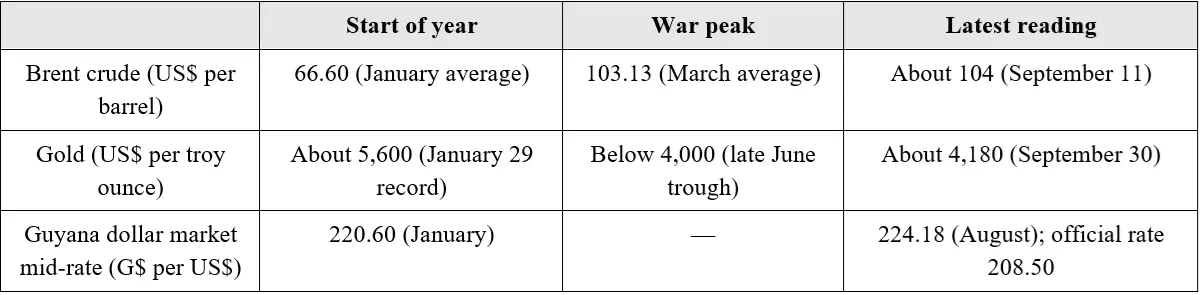
The Strait of Hormuz has been effectively closed since early March, while the International Energy Agency has called the result the largest disruption in the history of the oil market. Brent averaged US$66.60 a barrel in January, US$103.13 in March, and was trading above US$100 again in mid-September after a summer lull. In addition, the fourth year of the war in Ukraine – which continues to unsettle markets for grain, fertilizer and gas – compounds the global crisis buffeting small open economies such as Guyana. The result is that Guyana is a winner in one account and a loser in three others. The gains and losses fall on different people. This essay takes the various channels one at a time.
Table 1. Three prices in 2026
A crude exporter that buys its fuel
Guyana sells crude and buys refined products. The country has no refinery, its electricity is generated from imported heavy fuel oil and diesel, and its mining, rice and transport sectors run on diesel. Therefore, the war raises both the price Guyana receives and the price it pays, and the two have not moved together. Because Gulf refineries and product tankers were disrupted, the margin between crude oil and refined products – what is known as the crack spread – has widened sharply, with diesel and gasoline in the Atlantic Basin rising faster than crude oil itself. The gain shows up in the Natural Resource Fund, which received US$1.24 billion in the second quarter alone at an average realized price of about US$102 per barrel. The loss shows up at the pump, in the fuel bill of the Guyana Power and Light, and in the operating costs of every gold dredge and rice combine in the country.
Two features of the gain deserve mention. First, the higher price does not raise output. Production from the Stabroek Block is set by the capacity of the floating production vessels, so the windfall is a pure price effect, and it can reverse as quickly as it arrived. Second, under the amended withdrawal rule of the Natural Resource Fund the ceiling for any year is calculated from the previous year’s deposits, hence the 2026 windfall cannot be spent until 2027. While that lag is a useful stabilizer, it is also a political temptation.
The government often responds to the product price by cutting the excise tax on fuel. That stabilizes the pump price but shifts the cost onto the budget, and the relief is spread equally across rich and poor while the inflation it offsets is not. The one structural hedge against the product channel is the gas-to-energy project, which should replace imported heavy fuel oil with domestic gas in power generation.
The Ukraine channel arrives through agricultural shocks. Russia and Belarus are the principal potash exporters and Qatar is a major exporter of urea, so both wars have an adverse compounding effect on fertilizer inputs; meanwhile Ras Laffan was shut for a period this spring. Rice farmers therefore face higher fertilizer and diesel costs together, while wheat and vegetable oil prices directly increase the food import bill.
Gold and the search for something other than the dollar
Gold is Guyana’s second export, and it has had a remarkable and somewhat messy year. The price crossed US$5,000 an ounce for the first time in January and set its record near US$5,600 on January 29, before falling below US$4,000 by late June and recovering to about US$4,200 at the end of September. I am sympathetic to the popular view that gold rises with geopolitical risk; however, the 2026 path ran the other way, since the record came before the war and the decline came during the war. What has held the price at roughly double its 2024 level is not the war headlines but central banks, which bought 244 tonnes in the first quarter and a record 289 tonnes in the second, with Poland, China, India and Turkey among the steady buyers. Reserve managers are diversifying away from dollar assets as a matter of policy, and that puts a floor under Guyana’s gold revenue that has little to do with Hormuz.
The alternatives to the dollar being discussed are worth mentioning. Gold itself is being accumulated as a reserve asset; local-currency settlement within the BRICS grouping is being discussed; cross-border central bank digital currency platforms of the mBridge type have technical potential; and the gradual invoicing of some commodity trade in yuan has commenced. None of these has yet challenged the dollar's role as the invoicing currency for oil, gold, rice and bauxite, which is precisely why depreciation of the Guyana dollar cannot stimulate Guyanese exports, a point I return to below. Incidentally, US lawmakers have responded, passing the GENIUS Act of July 2025 to create new demand for the dollar through stablecoins. This will have unintended consequences that deserve an essay of their own.
Fiscal expansion, the cambio premium and who pays
Here is the channel my own research has emphasized, and it is domestic in origin even though the trigger is foreign. The 2026 Mid-Year Report records exports of nearly US$16.2 billion, a record by a wide margin, alongside an overall balance-of-payments deficit of US$293.9 million and a drawdown of the central bank’s reserves. The headline export figure overstates the dollars that stay. Cost recovery and profit repatriation by the oil companies remove most of them before they reach a Guyanese bank, so the domestic economy sees the government’s share and a smaller amount from other investors in shore-based activities. That share is then converted from US dollars into Guyana dollars when the government withdraws from the Fund, US$2.37 billion of it this year, and spent on contractors, government salaries, cash grants, tax reliefs, and other current expenditures. The Guyana dollars land in the commercial banks as excess reserves. Because the channel from bank reserves to lending is weak, the liquidity does not stay idle. It goes searching for foreign goods and foreign assets, which is to say it goes looking for US dollars at the commercial banks and non-bank cambios.
The result is visible in the exchange rate. The Bank of Guyana held the official rate at G$208.50 through August, while the market mid-rate slid from G$220.60 at the start of the year to G$224.18 at the end of August, a premium of about 7 percent. Importers, retailers and anyone paying a foreign invoice deal at the market price, not the official one. The war adds a second layer that my work with a co-author, Aleksandr Gevorkyan, on dominant currency shocks helps to explain. In periods of conflict the US dollar tends to strengthen as investors seek safety, and our panel results for commodity-dependent economies show that a stronger dollar and higher global volatility raise foreign exchange pressure in the periphery. Guyana’s peg to the dollar means the Guyana dollar appreciates against Brazil, China and Europe when the dollar rises, which slightly cushions the cost of non-US imports, but it does nothing for competitiveness and it does not relieve the pressure at the cambio.
Depreciation in Guyana is asymmetric. It raises the Guyana dollar cost of fuel, food, medicine and building materials almost immediately, while doing nothing for exports, since oil, gold, rice, sugar and bauxite are all invoiced and sold in US dollars at prices set abroad. The textbook expenditure-switching effect does not exist here; what exists is a regressive inflation tax. Wage earners and pensioners paid in Guyana dollars, with no indexation, lose in real terms. Holders of US dollar balances, exporters, and the government, whose oil revenue is in US dollars, are the winners.
The long game
The final channel is the slowest and the most consequential. Two energy wars in four years have persuaded the large importers to reduce their dependence on oil as a matter of national security rather than climate policy. India is pushing electric vehicles, solar panels on rooftops and elsewhere as well as ethanol blending, China’s oil demand is at or near its peak, and Europe has accelerated substitution for the second time this decade. The likely result is a long-term decline in the real price of oil that begins before Guyana’s fields are exhausted. For a country that commenced oil production late, the implication of Hartwick’s rule is instructive – produce while the price is high, but save a larger share of the proceeds in safe foreign assets that will still earn a return when the barrel is worth less. The tiers of the amended Natural Resource Fund rule, which allow 85 to 100 cents of every dollar deposited to be withdrawn the following year, were designed for a world in which oil keeps its value. The wars are a reminder that a high long-term valuation is less likely.
What follows
The net effect of the two wars on Guyana is not a single number. The NRF gains, the reserves are drawn down, the budget absorbs the fuel subsidy, the farmer pays more for urea, and the worker pays more for everything while earning the same. A government that wished to line up the gains with the losses would do three things, none of which requires new money. It can sterilize a larger share of each withdrawal by selling securities to the public rather than parking the liquidity in the banks, replace the flat excise cut with relief aimed at low-income households, and legislate a higher saving share in the NRF while the price is above US$100. The first stabilizes the cambio rate, the second protects the people the depreciation hurts, and the third prepares for the world the wars are quietly necessitating.