How Can the Natural Resource Fund Maintain Fiscal Stability for Foreign Investors?
Guyana's US$4.29B Natural Resource Fund shapes sovereign credit risk and the G$208.5 peg. Oil transfers now finance nearly a third of the national budget. Prof. Tarron Khemraj assesses what this means for creditors and direct investors, and proposes four reforms to strengthen confidence.

Most discussions of Guyana’s Natural Resource Fund (NRF) are conducted between the government and its citizens. Sometimes this discussion takes the form of a distribution of benefits to the present generation versus future ones – what economists call intergenerational equity. Since foreign investors read a sovereign fund through different lens, this essay asks what the Fund actually does for this class of investors who lend to Guyana or build a business here. The short answer is that the Fund performs a stabilizing role via a single mechanism, the conversion of oil dollars into Guyana dollars, but it does so only as much as the NRF withdrawal rule and the Bank of Guyana allow.
Two kinds of foreign investor
There are two kinds of foreign money that flow into Guyana. The first belongs to the creditor. This could be a bondholder, a bank syndicate financing an infrastructure project, or a development finance institution. The creditor wants to know one thing above all, namely whether the government can keep servicing its debt in the year the oil price collapses. For this reader the Fund is a backstop, and the relevant ratios are the balance of the Fund relative to external public debt and relative to a year of debt service. The Minister of Finance has already made the point in his own way by observing that the Fund alone is large enough to retire the external debt.
The second kind of money belongs to the direct foreign investor in a non-oil business, say a rice mill, a hotel, a fabrication company or a call center. This investor cares less about the Treasury’s balance sheet than about two practical matters. The first is whether the exchange rate at which profits are repatriated will still be around G$208.5 per US dollar in five years. The second is whether the government can keep paying its contractors and civil servants, who are the investor’s customers, without leaning on the central bank. For this reader the Fund matters because of what it does to the monetary system, not merely to the budget.
The balance in the fund
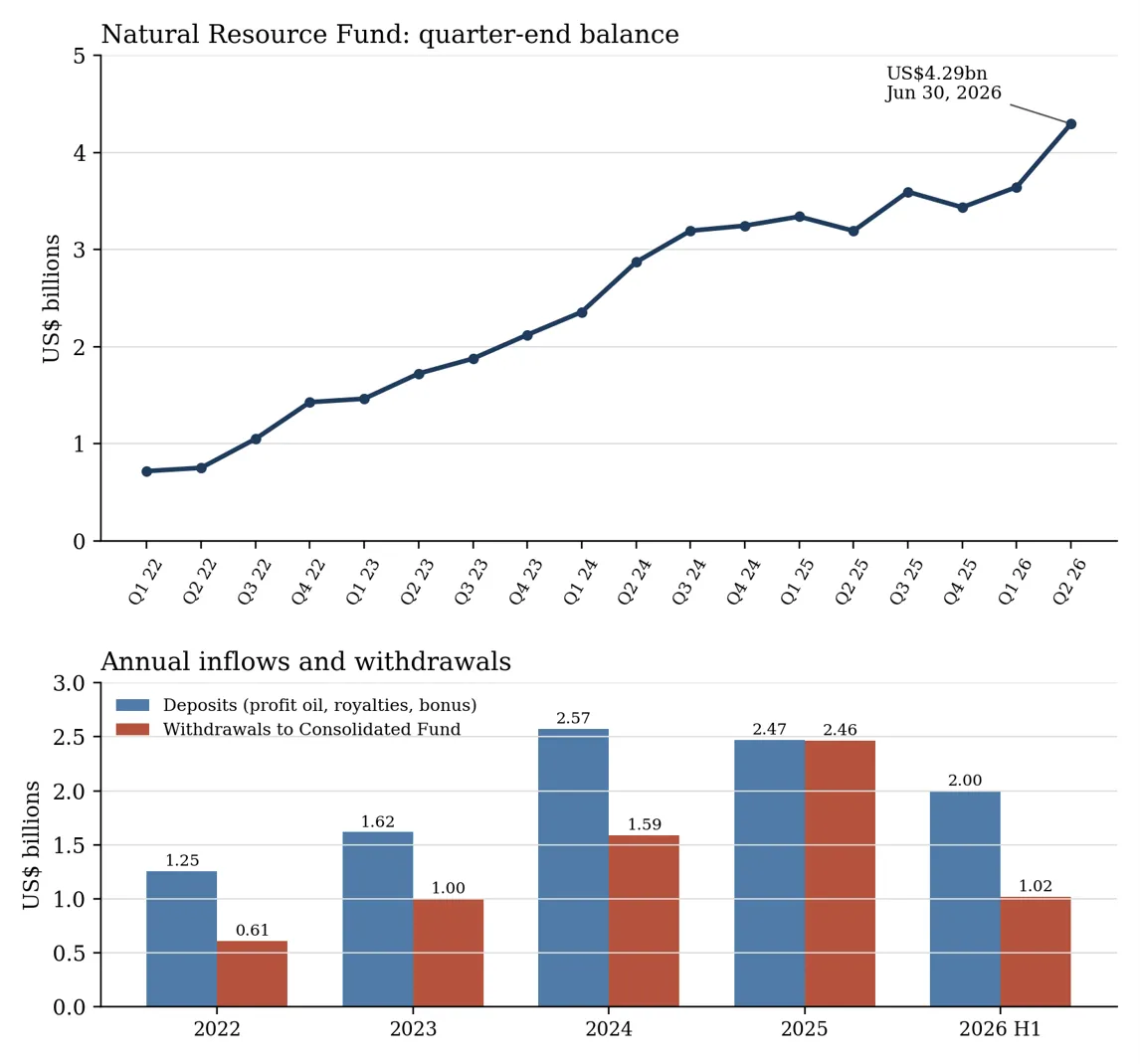
Figure 1 shows the quarter-end balance of the Fund since the first year of withdrawals, together with annual deposits and withdrawals. The Fund closed June 2026 at US$4.29 billion. Since the first lift of profit oil in March 2020 it has received US$10.52 billion, of which US$9.17 billion came from 117 cargoes of profit oil, US$1.34 billion from royalties and US$15 million from a signature bonus. Over the same period US$6.68 billion has been transferred to the Consolidated Fund. Therefore, roughly 63 cents of every dollar that entered the Fund has already left it. Deposits ran ahead of withdrawals in every year except 2025, when the two were almost equal at about US$2.47 billion.
Figure 1. The Natural Resource Fund, 2022 to mid-2026
To understand the withdrawal rule, let us work though a numerical example – as this is important for deciphering the stabilization argument outlined below. Under the 2021 Act as amended in 2024, the ceiling for any year is calculated from the deposits of the previous year, and it works in tiers: 100 percent of the first US$1 billion, 95 percent of the second, 90 percent of the third, 85 percent of the fourth, 50 percent of the fifth, and 10 percent of anything above US$5 billion. Deposits in 2025 amounted to US$2,471.5 million. Applying the tiers gives US$1,000 million plus US$950 million plus 90 percent of the remaining US$471.5 million, which is US$2,374.3 million – the exact amount Parliament approved for 2026. It also explains why 2026 is the first year in which the withdrawal is lower than the year before, since 2025 deposits were slightly below those of 2024 on account of softer oil price. A price fall reaches the budget with a lag of one year rather than immediately, thereby serving as a modest smoothing mechanism.
The same arithmetic holds in the reverse. The second quarter of 2026 alone brought in US$1.24 billion at an average realized price of US$102 per barrel, hence the ceiling for 2027 will jump. Whatever is deposited in a boom year becomes spendable the following year at 85 to 100 cents on the dollar. The tiers bite hard only above US$5 billion of annual deposits, a threshold Guyana will reach later this decade. Until then the rule is a mild brake, not a savings mandate.
One buffer, two accounts
Here is the part that both kinds of investor tend to miss, and it is the reason fiscal and monetary stabilization cannot be discussed separately in Guyana. The Fund is held in US dollars in an account at the Federal Reserve Bank of New York. The Consolidated Fund, into which every withdrawal must be deposited, is held in Guyana dollars at the Bank of Guyana (Guyana’s Consolidated Fund is similar in mechanism to America’s Treasury General Account). Therefore, every withdrawal is a foreign exchange transaction before it is a fiscal one. Someone must buy the dollars.
In practice the buyer is the central bank. The Bank of Guyana takes the US dollars into its international reserves and credits the government’s account with newly created Guyana dollars. Up to this point nothing has been spent, but the NRF balance is reduced by the amount withdrawn and the central bank’s foreign reserves larger by the same amount. From the creditor’s point of view the external cushion of the country has not changed; it has merely moved from one account to another inside the same building, so to speak. An investor who looks only at the NRF balance is therefore looking at half the picture; the relevant buffer is the sum of the Fund and the central bank’s foreign reserves.
The foreign direct investor should now see the second half of the mechanism. When the government spends those newly created Guyana dollars on contractors looking to import machines and inputs, it generates demand for US dollars. The Bank of Guyana then sells US dollars, thereby sterilizing or mopping up the initial Guyana dollar injections and furthermore closing the monetary circuit from the initial government spending. There is another form of government spending that engenders demand for US dollars such as public wages, part-time employment, cash grants, tax reliefs (yes, taxation is a drain of liquidity from the system), and other non-tradable expenses. These expenses are outside the closed monetary circuit I just outlined because they sit as non-remunerated excess liquidity in commercial banks. The banks earn nothing on these balances, and, as I have argued elsewhere, the channel from bank reserves to lending is weak in Guyana, so the liquidity does not sit quietly. It goes looking for foreign assets and foreign goods, which is to say it goes looking for US dollars at the cambios and the commercial banks. Hence the persistent complaints of foreign exchange shortages in an economy that is, in aggregate, awash in dollars. The soft peg at G$208.5 has held because the Bank of Guyana has been willing to sell US dollars back into the market, but every such sale drains the reserves that the NRF withdrawal had just topped up.
The fiscal side of the same story is the non-oil deficit. The IMF reports that the overall fiscal deficit widened from 5.1 percent of GDP in 2022 to 7.3 percent in 2024, which sounds manageable until one expresses it – as one should for an oil economy with enclave offshore oil production – as a share of non-oil GDP, where the deficit rose from 11.7 percent to 21 percent. The non-oil deficit is the spending that the non-oil economy cannot pay for on its own, hence the amount that must be financed by oil withdrawals or by borrowing. It measures how much of the state would have to shrink if oil revenue disappeared for a year.
Therefore, the question a foreign investor should ask is not how big the Fund is but two sharper ones: (i) how much of each withdrawal is sterilized rather than allowed to swell bank liquidity, (ii) and how quickly the non-oil deficit is being reduced as a share of non-oil GDP. The first governs the exchange rate the direct investor will face; the second governs the debt service the creditor will receive.
How much of the budget is oil-financed
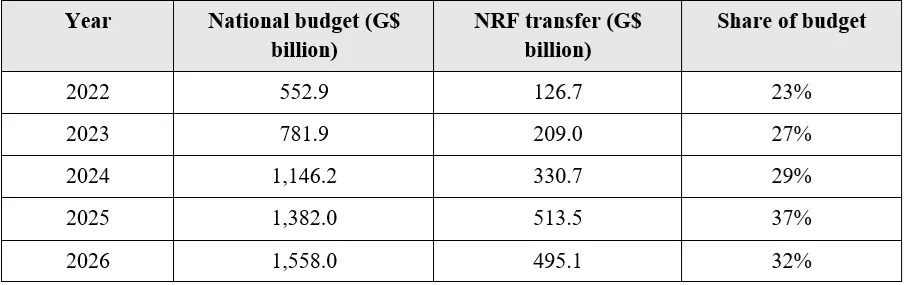
Table 1 shows the share of the national budget financed by transfers from the NRF. The share rose from under a quarter in 2022 to 37 percent in 2025 before easing to 32 percent in 2026 because of the lower ceiling. In 2026 the withdrawals, together with carbon credit inflows into the Consolidated Fund, are marginally larger than total tax revenue. I wrote in 2022 that the percentage of the budget funded by non-oil revenue would indicate how shrewd fiscal policy is, and the test still applies. For a creditor the mirror image is the more useful one. The share of the budget that would survive a year of zero oil revenue is now a little under two-thirds, and a good part of that is already financed by borrowing.
Table 1. Transfers from the NRF as a share of the national budget
The rules behind the numbers
Creditors price governance, and they price it whether or not the government thinks it fair. Several features of the 2021 Act should reassure them. The government cannot borrow against the Fund or lend from it. Every withdrawal requires a parliamentary vote. The Bank of Guyana publishes monthly and quarterly reports that are, in my experience, complete down to the individual lift, and the Fund has paid nothing in management fees because it has never left the overnight deposit account at the New York Fed. I am somewhat sympathetic to the view that a cash account earning under 3 percent annualized since inception is a costly way to hold US$4 billion; nevertheless, for a creditor the absence of investment risk is a feature rather than a problem.
Other features are less reassuring. The President appoints the majority of the Board, the Minister of Finance has considerable authority over the Investment Committee, and the macroeconomic committee of the 2019 Act, which would have given the public an independent view of the sustainable withdrawal, was dropped. The 2024 amendment, which widened the tiers from US$500 million to US$1 billion and raised the percentages, shows that the rule can be relaxed by a simple parliamentary majority. Neither Act clearly separates the management of the Fund from the management of the foreign reserves, a conflict I have raised before in 2020, and the opposition has litigation pending over the transparency of past withdrawals. This is unusual for a young oil exporter, but it does mean that the stability of the Fund depends on statutory rather than a constitutional foundation. In practice that means the creditor treats the Fund's balance as available to the government at short notice rather than as money set beyond its reach, and therefore does not credit it in full when judging how much of the debt service is secure.
Focus on the baseline, not the boom
The non-oil economy grew by about 14 percent in 2025, and the government projects 7.6 percent for 2026. The IMF’s medium-term baseline is more sober, namely 6.75 percent a year for the non-oil economy, about three points above the pre-oil decade. Therefore, a foreign investor should underwrite the baseline, not the boom. The recent growth is the product of a construction surge financed by the very withdrawals just described, and construction is the first thing to stop when withdrawals fall.
What would strengthen the investor’s case is not hard to list: a legislated floor on the saved balance, a published policy on how much of each withdrawal is sterilized, a clear statutory wall between the Fund and Bank of Guyana reserves, and a target path for the non-oil deficit. None of these requires new money, only that the government accept a rule it cannot easily change, which is, of course, the whole point of a rule.