Guyana’s Alignment with Brazil Will Facilitate Its Continental Destiny in South America
Guyana’s trade with Brazil grew from US$32 million in 2016 to over US$1 billion in 2025, yet its security ties run almost entirely through Washington. Sharmini Rampersaud argues that closer alignment with Brazil would balance that dependence and strengthen Guyana’s position on Essequibo and Mercosur.

According to the book Non-Western Middle Powers in the Multipolar Order, “Brazil as a Middle Power Historically: If there can be a definition of what a ‘middle power’ is in the international system, Brazil highlights that what a ‘middle power’ is in the international system is complex and historically dependent put such definitions to the test. In terms of geographic, economic, and military size, Brazil has always been an actor of consequence, depending on the frame of reference used to define it. Its land area of 3.3 million square miles and population of over 217 million people are each approximately half those of South America. Brazil’s diversified, relatively technically advanced economy and Gross Domestic Product of $1.95 trillion is the largest in Latin America and 8th in the world, ahead of those major Asian states and such as Italy and Canada. Brazil has a capable combined arms military force including approximately 360,000 active-duty personnel, larger than the rest of its counterparts in South America combined, including its own arms and aerospace industries, as well as its domestic satellite program and space launch sites on its national territory. Until it was scuttled in 2023, Brazil’s military had the only aircraft carrier in the region. It has a civilian nuclear program and ambitions to develop a nuclear submarine. To the extent that Brazil has not nuclear arms and ballistic missiles to fire them its restraint from doing so reflects a choice about how to maintain its security, rather than the incapacity to do so.”
Brazil is one of those countries viewed as a “middle power,” according to a World Economic Forum white paper. “Middle powers” are briefly defined as states that “sits below great powers but still exert influence over global politics meaning states with extensive diplomatic, economic, multilateral, and sometimes military clout.” Brazil is not only a middle power but also multi-aligned, especially in managing its geopolitics between the US and China in this pressured and chaotic multipolar world. Brazil is also elevated not only as a rising hegemon next to the US in Latin America, with the second-largest military, but also within BRICS and the G20. Oliver Stuenkel, in his Belfer Center research paper Multi-Alignment as Strategy: How Brazil Navigates Between Washington, Beijing, and the Global South, stated that Brazil, in its activist foreign policy, led the “challenging UN peace keeping mission in Haiti, proposed the ‘Responsibility while Protecting’ (RWP) concept for engagement during the military intervention in Libya, and seeking to negotiate a nuclear deal with Iran in 2010.” At the same time, Brazil is a member not only of BRICS and the G20 but also of IBSA, which consists of India, Brazil and South Africa.
The economic and trade relationship between Brazil and Guyana has grown rapidly since the return of President Lula as Head of State in Brazil. Brazil sees its connection to Guyana as a gateway to the Caribbean. Moreover, Brazil is a non-borrowing member of the Caribbean Development Bank (CDB). As an industrialized country, Brazil is a producer of both light and heavy manufactured products. Significant infrastructure projects are being developed to enhance connectivity and trade relations between the two countries. Key among them is the implementation of the Guyana/Brazil International Road Transportation Agreement that will facilitate the movement of goods and people. There are also plans for a road-rail network and fiber optic connection that will improve trade and communications between the two countries.
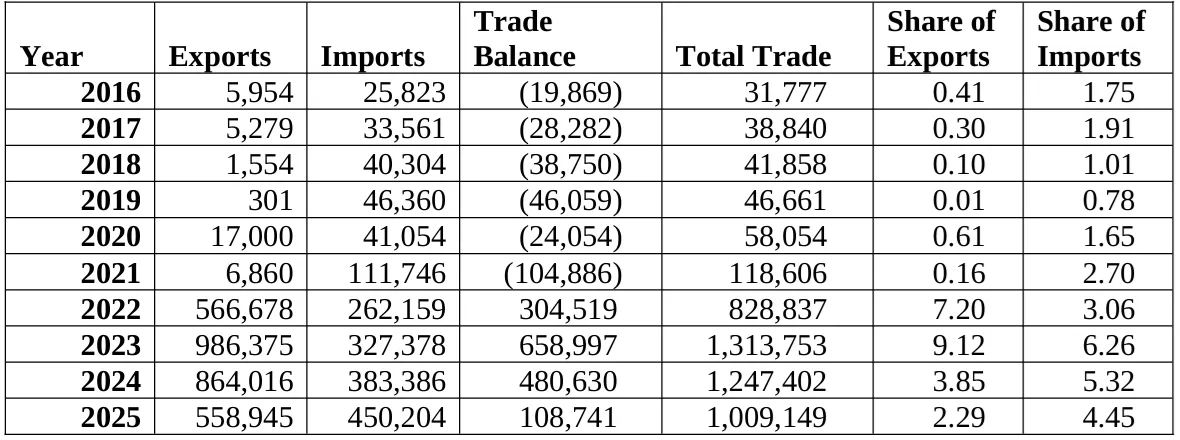
Trade between the two countries has grown rapidly, as the table below shows. Total trade increased by over 300% in the last ten years. Guyana’s trade with Brazil moved from a deficit of USD 19.9M in 2016 to a surplus of USD 108.7M in 2025, with crude oil accounting for the largest share of exports. Guyana also exports rice, aluminum ores and other minerals while it imports equipment mainly for the oil industry. There is investment interest in various sectors, which will facilitate even more trade.
1. Guyana-Brazil Trade Data 2016-2025
Brazil offers a unique opportunity to partner with Guyana in an intra-industry trade model, especially given both countries’ resource endowments in agriculture. Higher economies of scale will be an advantage not only to the two countries but also to the larger Caribbean economies that are large importers of goods. Of importance, on May 4, 2026, Guyana’s President Dr Irfaan Ali spoke at the Offshore Technology Conference (OTC) 2026 in Houston, Texas. According to the Office of the President of Guyana, “In addition to developing its own infrastructure and energy mix, the President also noted that Guyana is actively engaging bilateral partners such as Brazil, Suriname and French Guiana to explore the development of mega-scale regional power infrastructure and interconnection systems.” Looking to the future, there is talk of refining Guyana’s crude in Brazil, and research has started at the university level in Brazil.
Guyana’s major alliance is with the US, where the US is the dominant power and holds unilateral control over the country’s security and economic interests. There is a power imbalance, and Guyana needs to think of not putting all its eggs in one basket. With Brazil, there can be a balance-of-power arrangement, since Brazil’s economic and security interests are aligned with Guyana’s. That’s not to say Guyana should cut ties with the US, but one country should not be the dominant power, especially with its military and economic interests tied so deeply and interwoven in every aspect of the country. An important consideration is the ramifications of American foreign policy, especially now that Venezuela is being controlled by the US after the capture of Maduro. America’s Donroe Doctrine of controlling the Western Hemisphere and its security pact of the Shield of the Americas have been checked by President Lula’s victory in the 2026 general election. Guyana is a member of the Shield of the Americas and signed more security agreements with the Department of War at the Pentagon last month. One could argue that Guyana needs those security agreements with the US because of Venezuela’s illegal claim to Essequibo and threat to Guyana’s sovereignty. On the other hand, an arrangement with Brazil will secure Guyana’s borders and sovereignty since Brazil believes in multilateralism and international law and would support next year’s International Court of Justice decision in the case with Venezuela.
A timely Stimson article, Experts React: The Midterms and America’s Place in the World, stated: “Congress has also indicated its discomfort with Trump’s highly militarized approach to fighting organized crime in Latin America as part of a new regional coalition, the Shield of the Americas. Investigations and hearings into U.S. military strikes that have killed 244 individuals aboard speedboats suspected of smuggling drugs in the Caribbean and eastern Pacific are likely.” The article also pointed out that President Lula’s fourth-term victory in Brazil’s general election ended President Trump’s hopes of expanding the Shield of the Americas. Moreover, with Brazil and Mexico, the two largest countries in the region apart from the US, outside the Shield of the Americas, the success of the Donroe Doctrine is in doubt. The article couldn’t have said it better: “Taken together, the two elections cast doubt on the durability of Trump’s quest for regional hegemony, a strategy known as the ‘Donroe Doctrine.’ For the next two years, Trump’s regional alliance will continue to be shunned by the region’s two largest countries, Brazil and Mexico.”
Once again, Guyana could be caught in the crosshairs by fighting crime as part of the Shield of the Americas. The military strikes on individuals, especially in the Caribbean, are argued to violate international human rights law and the human rights of those individuals suspected of smuggling drugs. As Just Security stated, “State procedural duties to investigate potentially unlawful killings have long been recognized under IHRL as part of the State’s overarching positive obligation to protect the right to life. All human rights bodies take essentially the same approach to the parameters of this obligation. A useful summary can be found in the UN Human Rights Committee’s General Comment No. 36 (¶¶ 27-8 & 64), which sets out the Committee’s approach to interpreting Article 6 of the International Covenant on Civil and Political Rights (ICCPR), the instrument’s provision on the right to life.” Here again, Brazil is a firm believer in international law and can anchor Guyana with its support at various international bodies and forums, including the most important one, the United Nations.
Brazil’s military is the second largest in the Western Hemisphere after the US. With Brazil’s rise, there is a need for closer ties and collaboration with the Brazilian military. Embraer, Brazil’s largest multinational aerospace company, has been taking orders from NATO member countries. India, another middle power and the world’s largest democracy, has also placed orders with Embraer. Although Guyana signed security agreements with the Brazilian Army earlier and received some training, that’s not enough. There is a need for closer ties, especially with a future superpower in the Western Hemisphere. Of note, Brazil is developing its first nuclear-powered attack submarine. According to the Georgetown Security Studies Review at Georgetown University, “On October 4th, the Brazilian state-owned defense company Itaguaí Construções Navais and the Brazilian Navy cut the first steel plates of a test section of the Álvaro Alberto submarine, a small but significant milestone in Brazil’s quest for a nuclear-powered, conventionally-armed, attack submarine.”
Guyana’s close proximity and geographical border with Brazil is a cornerstone of Guyana’s South American Continental Destiny. Given its geographical location, Guyana forms the gateway to Latin America and the Caribbean. With Guyana being an associate member of Mercosur, alignment and closer ties with Brazil could facilitate full membership. Brazil’s history of rising to a “middle power” can be traced in the international system, and Guyana can learn from such experience. Guyana should not put all its eggs in one basket, and as such, Brazil forms a balance to America’s dominance in Guyana. Not only can we learn to be self-sufficient as Brazil is, but Brazil would also be a good mentor and protector of our little corner of the world.
References
- Kassab, Hanna Samir, and Ann Natalie Ghosn. Non-Western Middle Powers in the Multipolar Order. New York: Routledge, 2026.
- Selcher, Wayne A. Brazil in the International System: The Rise of a Middle Power. New York, Routledge, 2028
- World Economic Forum. Middle powers: what are they and why do they matter? https://www.weforum.org/stories/geo-economics-and-politics/middle-powers-multilateralism-international-relations
- Stuenkel, Oliver. Multi-Alignment as Strategy: How Brazil Navigates Between Washington, Beijing, and the Global South. Belfer Center for Science and International Affairs. https://www.belfercenter.org/research-analysis/multi-alignment-strategy-how-brazil-navigates-between-washington-beijing-and
- Stimson. Experts React: The Midterms and America’s Place in the World. https://www.stimson.org/2026/experts-react-the-midterms-and-americas-place-in-the-world/
- Ward, Shane. The Strategic Rationale for Brazil’s Nuclear Submarine Does Not Hold Water. Georgetown Security Studies Review, Georgetown University. https://gssr.georgetown.edu/the-forum/topics/defense/the-strategic-rationale-for-brazils-nuclear-submarine-does-not-hold-water/
- Schmitt, Michael, and Marko Milanovic. The International Law Obligation to Investigate the Boat Strikes. https://www.justsecurity.org/127136/international-law-obligation-boat-strikes/
- Ministry of Foreign Affairs Guyana.
- Office of the President Guyana. World needs balanced, responsible energy future: President Ali to OTC 2026.